
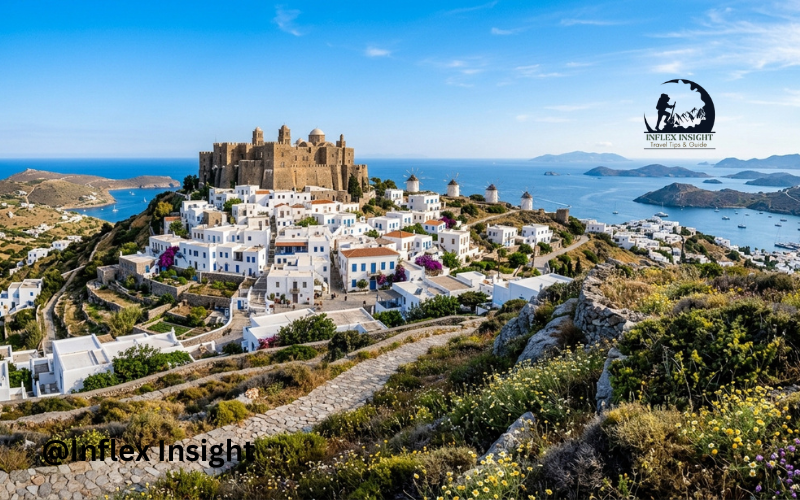
The island of Patmos in the Aegean Sea is a small Greek destination shaped by sacred history, traditional architecture, rocky landscapes, and clear coastal water. It belongs to the Dodecanese group in southeastern Greece but feels calmer than many busy resort islands.
Patmos is best known for the Cave of the Apocalypse and the Monastery of Saint John the Theologian. Together with historic Chora, they form a UNESCO World Heritage Site. The island also offers beaches, walking paths, waterfront dining, and quiet villages. First-time visitors should expect beautiful views, steep lanes, seasonal transport, and a slow style of travel.
Where Patmos Is Located in the Aegean Sea
Patmos lies in the southeastern Aegean near Lipsi and Leros. Ferries also connect it with islands such as Kos, Kalymnos, and Rhodes. Its position placed it along old routes linking mainland Greece, Asia Minor, and the eastern Mediterranean.
Although compact, Patmos has an irregular shoreline filled with bays, headlands, and coves. Low hills, dry slopes, and exposed rock shape the scenery, while the sea remains visible from many roads and paths. This geography helped Patmos become both a retreat and a stopping point for sailors, traders, and pilgrims.
The History That Shaped Patmos
Patmos has traces of ancient settlement, but its strongest identity comes from early Christianity. According to tradition, Saint John was exiled here during the Roman period and received the visions recorded in the Book of Revelation. The story made Patmos an important place of pilgrimage.
The monastery founded in 1088 became the center of island life, and Chora developed around its walls. Byzantine, Ottoman, and modern Greek periods all left their mark. Prosperous merchants built impressive houses under Ottoman rule, while Patmos joined the modern Greek state with the Dodecanese in 1948.
The Cave of the Apocalypse and Patmos’s Spiritual Importance
The Cave of the Apocalypse stands between Skala and Chora. Tradition says Saint John received his visions here and dictated them to his disciple Prochoros. The cave now sits within a religious complex, but its natural rock formations remain visible.
This is an active place of worship, not an ordinary attraction. Its small interior is reached by steps, which may challenge visitors with limited mobility. Wear modest clothing, speak quietly, follow photography rules, and never interrupt a service. Religious and nonreligious visitors alike can appreciate its connection between faith, history, and landscape.
The Monastery of Saint John the Theologian
The Monastery of Saint John the Theologian rises above Chora like a stone castle. Monk Christodoulos founded it in 1088 with support from Byzantine emperor Alexios I Komnenos. Its walls, towers, chapels, cells, and courtyard reflect both worship and the need for protection.
The monastery preserves manuscripts, icons, church objects, and religious art, some displayed in its museum. Surrounding viewpoints overlook Chora’s white houses and the Aegean. Because the monastery remains active, visitors must dress respectfully, stay quiet, and observe access restrictions.
Chora: The Historic Heart of Patmos
Chora is the island’s historic capital. Whitewashed homes, stone walls, courtyards, churches, and old mansions fill narrow lanes beneath the monastery. Streets designed mainly for walking help preserve its peaceful atmosphere.
Small squares, cafés, rooftop views, and glimpses of the sea reward slow exploration. Chora is also a living community rather than an open-air museum. Keep noise low, avoid blocking doorways for photographs, and respect private property. Comfortable shoes are important because many lanes are steep and uneven.
Skala and the Island’s Main Harbor
Skala is the main port and practical center of Patmos. Its waterfront contains shops, cafés, restaurants, pharmacies, travel services, and many accommodation choices. It is the easiest base for visitors who value convenience.
Ferries and excursion boats make Skala lively by day, while the harbor becomes relaxed in the evening. Buses and taxis leave from the area for Chora, Grikos, Kambos, and several beaches. Travelers seeking greater quiet may prefer a smaller village.
The Villages and Quieter Corners of Patmos
Grikos, south of Skala, sits beside a sheltered bay and suits travelers wanting easy sea access and quiet evenings. Nearby Petra Beach and Kalikatsou Rock add natural interest.
Kambos, toward the north, combines a relaxed village with a popular beach. Smaller settlements offer even more peace but fewer transport and dining choices. Chora is best for history, Skala for convenience, Grikos for a calm coast, and Kambos for a beach-focused stay.
Beaches and Coastal Landscapes Around Patmos
Patmos has a varied coast of pebbled bays, coves, rocky swimming areas, and several sandy stretches. Kambos and Agriolivado are easy to reach and usually have seasonal facilities. More remote Psili Ammos is reached by a footpath or, when operating, an excursion boat.
Conditions change with the wind, so a calm bay may become exposed. Popular beaches can offer loungers and tavernas in summer, while quiet coves may have no shade, water, or services. Carry sun protection and drinking water; water shoes can also be useful.
Nature, Walking Routes, and Aegean Views
Walking is one of the best ways to understand the island of Patmos in the Aegean Sea. Old paths and quiet roads link villages, sacred sites, hills, and beaches. The route between Skala, the cave, and Chora is rewarding but steep.
Dry slopes, herbs, shrubs, exposed rock, and open sea views define the landscape. Walk early or late to avoid strong heat. The hills near Chora and Kastelli are good sunset areas. Stay on established paths, carry water, and remove all waste.
Local Culture and Everyday Island Life
Religion remains visible through monasteries, chapels, feast days, bells, and community traditions. Orthodox Easter is especially meaningful, and Holy Week ceremonies attract residents and visitors. These are living expressions of faith, not tourist performances.
White houses, stone details, flat roofs, and wooden doors strengthen the island’s identity. Tourism supports many businesses, but Patmos keeps a slow rhythm. Dress appropriately near sacred buildings and remember that smaller businesses may follow seasonal or changing hours.
Food and Dining on Patmos
Patmos offers Greek and Dodecanese flavors, including fish, seafood, grilled meat, vegetables, salads, local cheese, and seasonal produce. Patmian cheese pie is a well-known specialty, while bakeries sell pastries and sweets.
Skala has the widest dining choice. Village tavernas and beachside restaurants often provide simpler menus and quieter settings. Evening meals may begin late, and reservations are helpful in July and August, especially at small restaurants with sea views.
How to Reach the Island of Patmos
Patmos has no commercial airport, so every visit includes a sea journey. Ferries operate from Piraeus, the main port serving Athens, and Visit Greece gives a typical journey time of seven to twelve hours. Overnight services can be convenient when available.
Travelers can also fly to an island with an airport, such as Kos, Leros, Kalymnos, or Samos, and continue by ferry. Connections vary by season and may not align on the same day. Confirm the whole route before booking separate tickets, allow time for delays, and recheck the ferry operator’s current schedule before departure.
Getting Around Patmos
Public buses connect Skala with Chora, villages, and several beaches, with more service during the main season. Taxis are practical, but demand rises around ferry arrivals. Cars and scooters provide flexibility, although narrow roads and limited parking require care.
Walking works well within Skala and Chora but is harder in hot weather. Seasonal boats may serve beaches or nearby islets when conditions allow. Always confirm the final bus or boat back before leaving.
The Best Time to Visit Patmos
Late spring and early autumn usually balance warm weather, lighter crowds, and comfortable walking. May, June, September, and early October can be especially appealing, though business hours vary.
July and August are hottest and busiest, so early booking is important. Winter is quiet, with fewer ferries and many seasonal closures. Easter offers a meaningful cultural experience but also attracts pilgrims. Weather can disrupt sea travel in any season.
Where to Stay on Patmos
Patmos offers small hotels, guesthouses, apartments, villas, and traditional homes. Skala is convenient for ferries and services. Chora provides history but requires more uphill walking. Grikos suits quiet coastal stays, while Kambos is convenient for the beach.
Check the property’s exact location because some rooms are far from transport or reached by steep paths. Confirm air conditioning, parking, luggage help, and the nearest bus stop. Popular rooms can sell out early in high season.
Planning a Balanced Patmos Itinerary
A short visit should cover Chora, the monastery, the Cave of the Apocalypse, and the coast. Three or four days allow time for Grikos, Kambos, a longer walk, and an evening in Skala. Longer stays make room for Psili Ammos, small museums, remote chapels, or a boat excursion.
Patmos is better enjoyed slowly. Pairing one cultural visit with a beach, village, or walk each day creates a comfortable rhythm and avoids exhausting travel in the heat.
Practical and Respectful Travel Tips
Pack light clothing plus something that covers shoulders and knees for monasteries and churches. Good shoes help on stone lanes and rocky paths. Carry sunscreen, a hat, water, and some cash because smaller businesses may not always accept cards.
Follow signs, avoid touching artwork, keep voices low, and ask before photographing ceremonies or people. Use marked paths, reduce waste, and never remove plants or stones. Choosing local guesthouses, bakeries, shops, and tavernas helps the community benefit from tourism.
Conclusion
The island of Patmos in the Aegean Sea combines sacred history, preserved architecture, clear water, and a peaceful landscape. Its monastery and cave provide spiritual importance, while Chora, Skala, villages, beaches, and walking routes reveal everyday island life.
Patmos should not be rushed. A rewarding visit balances major landmarks with simple pleasures such as a quiet lane, local meal, sheltered swim, or harbor view. Careful planning and respect for living traditions help visitors experience its lasting character.
FAQs
1. What is the island of Patmos famous for?
Patmos is famous for its connection to Saint John and the Book of Revelation. The Cave of the Apocalypse, the monastery, and historic Chora together form a UNESCO World Heritage Site.
2. Is Patmos in the Aegean Sea?
Yes. Patmos is located in the southeastern Aegean Sea and belongs to Greece’s Dodecanese island group. It lies near Lipsi and Leros and has ferry connections with several other Greek islands.
3. Does Patmos have an airport?
No, Patmos does not have a commercial airport. Visitors must arrive by ferry, either from Piraeus near Athens or from another island with an airport and suitable sea connections.
4. How many days are enough for Patmos?
Three to four days cover the sacred sites, Chora, Skala, and a few beaches. Five days or more allow for slower walks, quieter villages, and boat excursions.
5. Is Patmos suitable for travelers who are not religious?
Yes. Although faith is central to the island’s identity, Patmos also attracts visitors for its historic architecture, beaches, walking routes, food, coastal scenery, and peaceful atmosphere. All travelers should treat its active religious sites respectfully.