
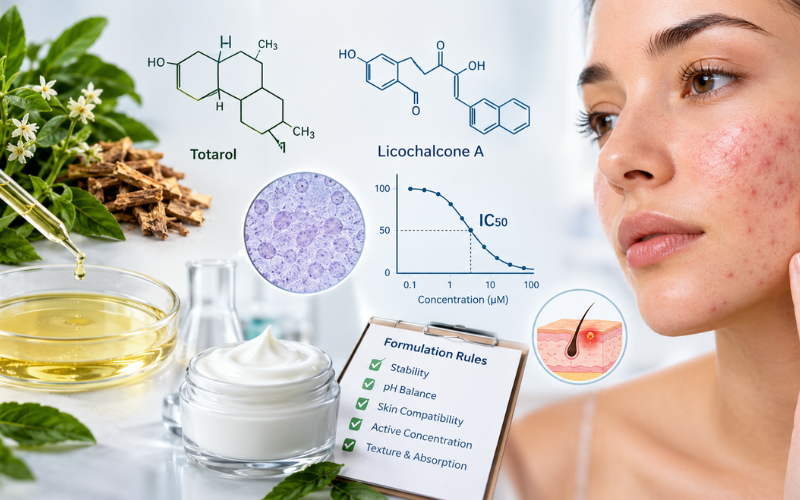
Drop the harsh acids. Stop stripping the skin barrier to clear a breakout. Formulators often rely on high-dose benzoyl peroxide or synthetic antibiotics to tackle acne. The result? Dry, peeling, and irritated skin. Is there a better way? Yes. We just need to look at plant-derived molecules with actual clinical backing.
At Shaanxi Huatai Bio-Fine Chemical Co., Ltd. (glabridinchina.com), we manufacture high-purity botanical actives. We skip the marketing fluff and focus on raw chemistry. Today, we break down two specific molecules that handle the entire acne lifecycle: Totarol for bacterial control and Licochalcone A for severe redness.
Totarol: Breaking the Bacterial Wall
Totarol is a diterpene extracted from the heartwood of the Totara tree. It is not a gentle, passive plant extract. It actively disrupts the bacterial cell membrane. It destroys the respiratory electron transport chain in Gram-positive bacteria. This makes it lethal to Propionibacterium acnes (P. acnes).
How lethal? Look at the Minimum Inhibitory Concentration (MIC) data. Lower numbers mean higher potency.
| Pathogen Target | Totarol MIC (mcg/mL) | Salicylic Acid MIC (mcg/mL) | Benzoyl Peroxide MIC (mcg/mL) |
| Propionibacterium acnes | 0.78 – 1.56 | 250.0 – 500.0 | 12.5 – 25.0 |
| Staphylococcus aureus | 1.56 – 3.12 | > 500.0 | > 50.0 |
| Streptococcus mutans | 1.56 – 3.12 | N/A | N/A |
Totarol neutralizes P. acnes at a fraction of the dose required for standard acne treatments. You only need 0.1% to 0.2% in a formula to see results. But you cannot just drop it into water. Totarol is aggressively hydrophobic. It will float and ruin your batch. You must pre-dissolve it in propanediol or a carrier oil at 40 to 50 degrees Celsius.
Licochalcone A: The Inflammation Switch
Killing the bacteria is only half the job. The lingering problem is the massive immune response. The skin turns red, swells, and eventually leaves a dark post-acne mark. Licochalcone A stops this cycle.
Licochalcone A is a chalconoid found in the root of Glycyrrhiza inflata (Chinese licorice). It acts as a direct off-switch for inflammation. It strongly inhibits the cyclooxygenase (COX-2) and lipoxygenase (LOX) pathways. This stops the skin from producing the chemicals that cause redness and swelling.
Check the IC50 test data. This measures how much of the active is needed to cut the inflammatory response in half.
| Inflammatory Marker | Licochalcone A IC50 (Micro-molar) | What This Means for the Skin |
| PGE2 Release | 0.45 | Drastically reduces physical swelling and pain. |
| LTB4 Production | 0.82 | Stops white blood cells from flooding the area. |
| ROS (Free Radicals) | 1.15 | Prevents cellular damage and hyperpigmentation. |
When you apply Licochalcone A to an active breakout or sunburn, the redness fades fast. It calms the skin down at a cellular level.
The Chemistry: Specs and COA Checklist
Can you mix them? Absolutely. Both are oil-soluble. Both thrive in slightly acidic formulas. But you need to buy the right grade. Cheap extracts contain useless plant resins that oxidize. Always demand a strict Certificate of Analysis (COA) from your supplier.
Here are the hard specs from our production lines at glabridinchina.com.
| Specification | Totarol | Licochalcone A |
| Appearance | Pale yellow crystalline powder | Yellow fine powder |
| Purity Target | > 98% (HPLC) | > 20% or 40% (HPLC) |
| Optimal pH Window | 4.5 – 6.5 | 5.0 – 7.0 |
| Solubility Phase | Lipids, Glycols, Ethanol | Glycols, Carrier Oils |
| Heat Stability | Up to 80 degrees Celsius | Sensitive (Keep below 60 degrees Celsius) |
If a supplier hides the HPLC chromatogram, walk away. A muddy brown Licochalcone extract will tint your final product and degrade rapidly.
Blueprint for an Anti-Bacterial Soothing Emulsion
Let us put this data into a real-world application. Here is a baseline chassis for a lightweight, acne-clearing gel-cream.
| Phase | Ingredient (INCI) | Percentage (%) | Functional Role |
| A | Water | Q.S. to 100 | Hydration base |
| A | Glycerin | 4.0 | Humectant |
| B | Squalane | 4.0 | Non-comedogenic lipid |
| B | Caprylic/Capric Triglyceride | 4.0 | Solvent for actives |
| B | Totarol | 0.1 | Anti-bacterial agent |
| C | Propanediol | 3.0 | Solvent for Phase C |
| C | Licochalcone A (40%) | 0.2 | Anti-inflammatory redness reducer |
Process: Melt Phase B at 50 degrees Celsius until the Totarol is fully clear. Emulsify Phase A and Phase B. Let the mixture cool down below 45 degrees Celsius. Pre-dissolve Licochalcone A in the Propanediol (Phase C) and add it to the main batch. This two-step process protects the Licochalcone A from heat degradation.
Industry Trends and Compliance Edge
The regulatory landscape is shifting. The EU and FDA are tightening restrictions on synthetic preservatives like triclosan and certain parabens. Consumers are downloading ingredient analyzer apps. They want “clean clinical” products.
This duo gives formulators a massive advantage. You get medical-grade efficacy from purely botanical sources. Totarol even acts as a secondary preservative, boosting the shelf life of your product. You pass the regulatory checks, satisfy consumer demand for plant-based solutions, and actually deliver visible results on the skin.